
Social Media Risks: Common Dangers and How to Stay Safe
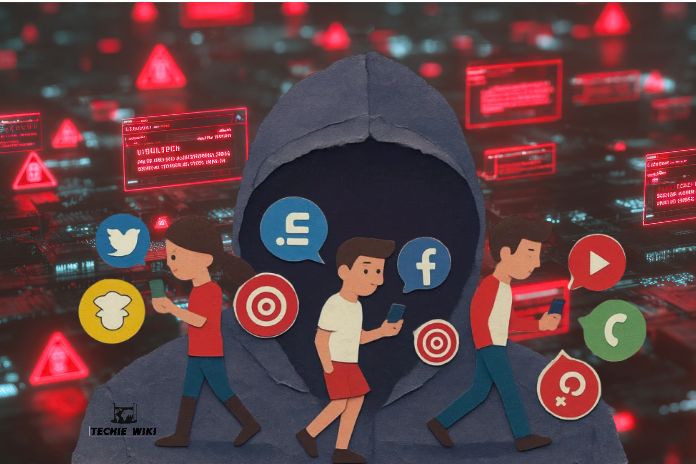
Social media has become a major part of our daily life. We use social media to connect with people from all over the world. On social media we communicate with friends, relatives, and share information regarding various topics.
However, using social media can also involve various risks such as involving privacy, security, mental well-being, and personal safety. Many people on social media face cyberbullying, scams, phishing, misinformation, and exposure to inappropriate content at a very young age.
It is very important for users to understand these risks by following safe online practices. By following these safe online practices can help to protect themselves from risks and dangers of social media
Risks and Dangers of Social Media
The rise of social media in the early decades of the 21st century has transformed it into a vital meeting place and platform for information exchange. However, despite the fact that this exchange is, in principle, governed by a set of rules imposed by the company managing the service, what happens within these virtual communities is not always legal, ethical, or safe.
This is partly because these virtual communities bring together people who are both known and unknown, sometimes anonymous or using fake profiles, whose intentions are not always easy to discern. This adds another layer of complexity to the inherent risks of the internet, such as spyware or hackers.
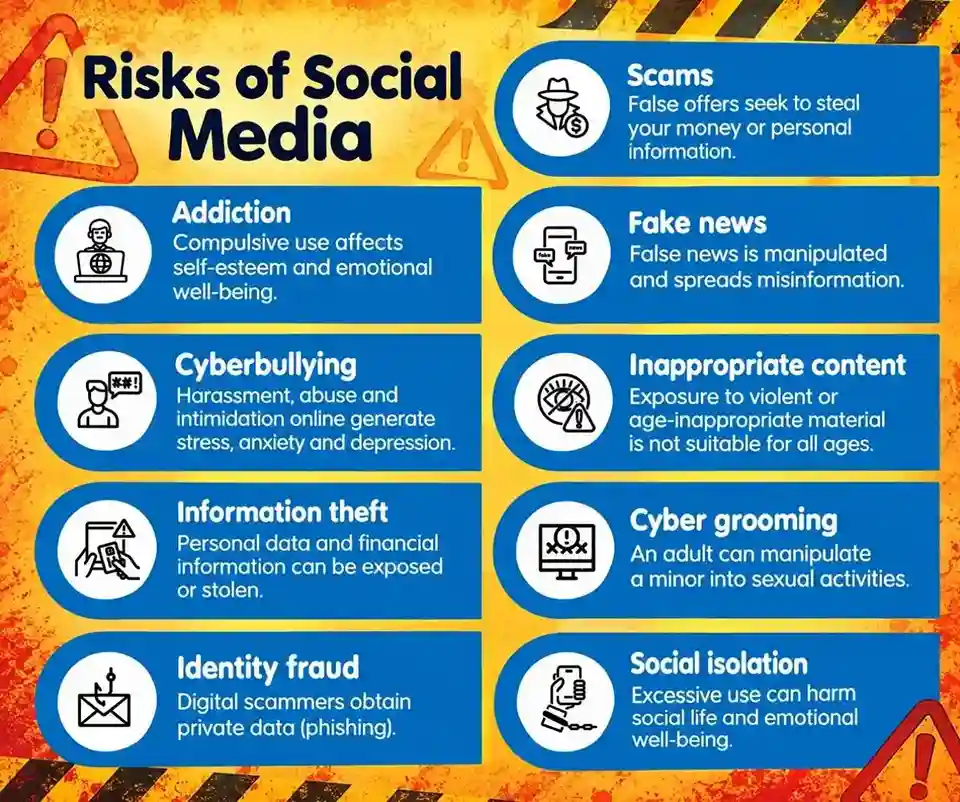
Main Risks and Dangers of Social Media
- Addiction
- Cyberbullying
- Theft of sensitive information
- Phishing or identity theft
- Scams
- Fake news
- Exposure to inappropriate content
- Cyberrooming
- Social alienation
In general, these risks can be reduced through safer and more responsible use of social media. This requires education and awareness of its advantages and disadvantages, and above all, passing this knowledge on to minors.
Social Media Addiction
The impact of social media on our emotions is a controversial and widely studied topic today. It’s known that social networks can foster a kind of addiction, encouraging their use through subliminal rewards. The effect of their notifications on the brain is sometimes described as a “dopamine hit.”
At the same time, this often negatively impacts users’ self-esteem due to the competition for social approval. Social media can give users the impression of belonging to a world of popularity, happiness, intensity, or success that may not reflect their real lives, which can be associated with anxiety or depression.
Cyberbullying
Cyberbullying is an aggressive form of harassment that occurs through online mechanisms. This behavior can be very common on social media, where aggressive and often anonymous users, known as trolls or haters, harass, insult, and bully others.
The dynamics of cyberbullying can be particularly harmful to young users, who are ill-prepared to identify and deal with this type of toxic behavior, or to those who place undue importance on social media interaction. This can lead to stress, anxiety, or outbursts of anger, and can sometimes extend beyond the social media environment to affect other aspects of real and digital life.
Theft of Sensitive Information
One of the major drawbacks of the internet, and especially social media, is the ease with which private or confidential information can become public or fall into the wrong hands.
Among the data that can be stolen are the location, recorded by the cell phone or any device equipped with a GPS; the address of work, school or home; credit card data, telephone number or bank account data.
Something similar happens with photographs, videos, or intimate messages, which can be made public or sold on adult content websites.
Phishing or Identity Theft
Phishing is a malicious strategy to obtain a user’s sensitive data by impersonating another person or institution the user trusts. In this way, the user voluntarily hands over their data to unscrupulous third parties who will use it against them.
Phishing is very common in mass emails (known as spam) that offer rewards, fantastic promotions, or unexpected gifts, hoping that some unsuspecting user will respond. The same occurs on social media, where fake profiles ask for help or impersonate bank representatives, all in order to obtain sensitive data.
Scams on Social Media
Scams are very common on social media, sometimes originating from fake profiles and other times from advertisements paid for by third parties. These types of deceptive offers are often targeted at vulnerable audiences, such as young people, senior citizens, or those unfamiliar with the internet.
Lured by the offer of a good price product, a free service, or some similar promise, victims of scams accept bank charges, download malicious software, or hand over their digital data (name, age, email, social media profiles), which will then be sold to third parties and used for advertising bombardment.
Fake News and Misinformation
Fake news is a very common form of toxic content on social media. Disguised as official news, it spreads rumors or delusional ideas, usually related to politics, health, or current events.
Fake news often radicalizes opinions on a topic, especially among users who are more emotionally vulnerable or less prepared to critically analyze what they consume online. This can serve various purposes, such as manipulating public opinion, inducing people to buy a product, or simply drawing massive attention to websites that rely on advertising revenue.
Exposure to Inappropriate Content
Although social media platforms have certain mechanisms to filter pornography, explicit violence, or gory images, it is always possible for this type of material to appear and reach younger users who are less prepared to deal with it.
Furthermore, the line between permitted and prohibited material is not always easy to discern, and much biased, disturbing, or explicit content can evade restrictions. Many images or videos intended for an adult audience can cause distress, discomfort, or confusion in child users.
Cyberrooming and Online Grooming
Minors are particularly vulnerable on social media, especially when they use it without adult supervision. Contact with strangers on social networks, or even with people pretending to be their age, can be a risk factor for children, as it exposes them to cyber grooming.
Cyber grooming (when done online), refers to child sexual exploitation, specifically attempts by adults to gain the attention and trust of children in order to later induce them to meet in person. This behavior may also be punishable by law, depending on the jurisdiction.
Social Alienation
Social media can be very seductive, as it’s designed to capture the user’s attention for as long as possible. This can lead many people to social alienation, meaning they neglect crucial aspects of their real lives, such as work, studies, or interpersonal relationships, in favor of their virtual lives.
Thus, users whose real lives are far less rich than their virtual lives may end up spending excessive time on social media. This brings with it numerous psychological and emotional consequences, such as depression, anxiety, greater difficulty in establishing real relationships, and a sense of unreality, among others.
How to Prevent the Dangers of Social Media
The general advice for avoiding most risky situations on social media is to understand it as just another tool and activity in daily life, which should therefore be used in moderation and responsibly. It is not advisable to view social media as an escape from real life or as a more important activity than real life itself.
At the same time, to avoid other more specific risks, it is advisable to follow these tips:
- Protect your private information. It’s not advisable to post absolutely everything on social media, as not everyone uses it for the same purpose. Special attention should be paid to who you send sensitive or delicate information to—information that could later be used for malicious purposes.
- Do not accept friend requests from strangers, especially those that seem too good to be true or who ask for information or money in a rushed manner. Always verify that the person you are speaking with is indeed who you think they are.
- Use strong passwords. A strong password is one that does not contain easily obtainable personal information (such as birthdates or initials) and is long, unique, and difficult to guess. Passwords should also be changed if they are compromised.
- Supervising minors. There are options to give parents control over their children’s activity on social media. But nothing can replace the power of education and trust: children need to be aware of the risks they face in the virtual environment and should be able to consult their parents with any questions or concerns.
- Be wary of anything without a source. Messages from anonymous profiles, texts without authorship, and news stories without any journalistic source are often false and even potentially dangerous. Just because a message comes from someone you know doesn’t mean that person knows where the information originated or what’s behind the supposed news.
- Knowing when to stop. Like any other activity in life, social media should have a time and place for its use, and it shouldn’t invade other aspects of daily life. A healthy user knows when to disconnect and focus their attention on the immediate reality.
Conclusion
Social media has many uses and it provides many ways to connect with people all over the world. It helps users to share information and stay updated with the latest trends. However, it also comes with many risks and dangers like scams on social networks, cyberbullying, privacy problems, and exposure to inappropriate content. It is very important for users to understand these risks by protecting personal information and using social media in a responsible manner.
Also Read: How Can ChatGPT Be Effectively Integrated Into Social Media Strategies
