
5 Common Artificial Intelligence Myths Debunked: Facts and Misconceptions
We encounter a large number of articles that try to explain what Artificial Intelligence (AI) is and what we can do with it. Unfortunately, this information overload leads us to encounter some myths that are completely wrong.
Executives and managers of companies that aim to compete in a market driven by innovation must be able to distinguish reality from myth. Only then will they be able to effectively develop their next strategies (or improve their current ones) so that projects ultimately deliver truly positive results for their businesses.
In this article, we help debunk some of the most common misconceptions about artificial intelligence.
5 Artificial Intelligence Myths vs. Facts
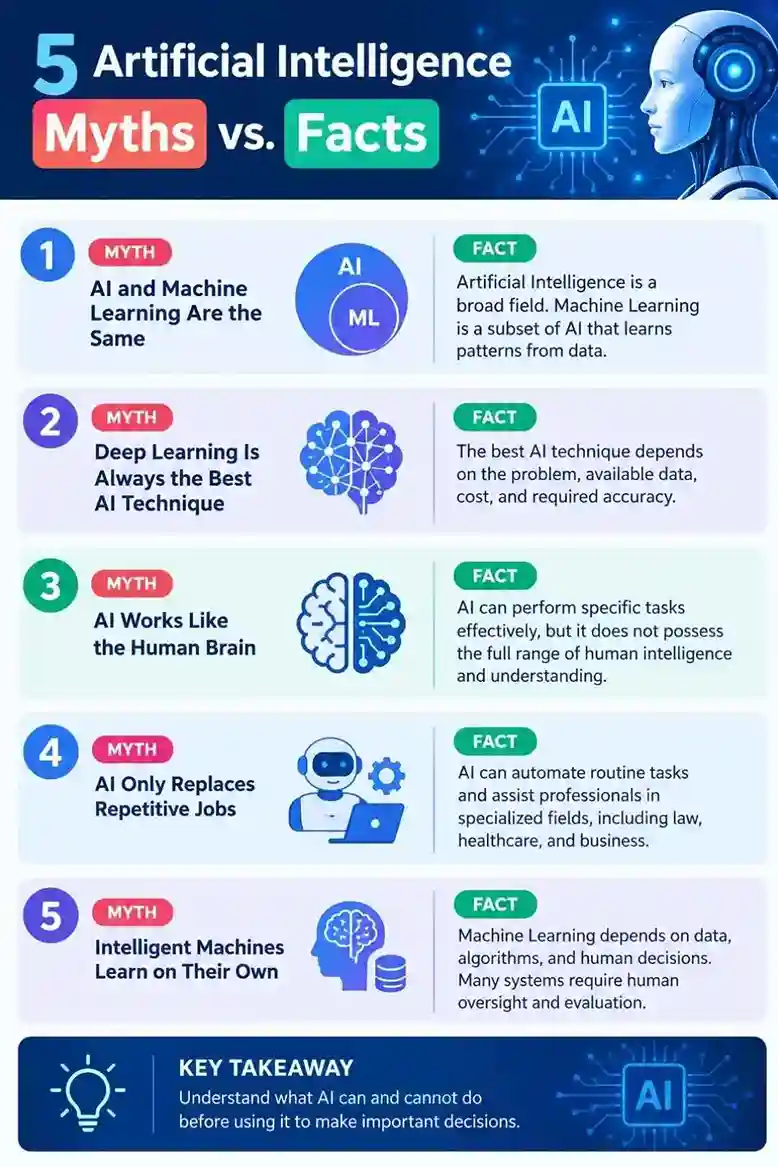
Myth 1: Artificial Intelligence and Machine Learning Are the Same
This is probably one of the most common misconceptions. It’s likely because both “machine learning” (ML) and “artificial intelligence” are buzzwords in the business and technology world and are sometimes used incorrectly.
“Artificial Intelligence” is a broad field that includes techniques and technologies such as machine learning, robotics, knowledge-based systems, and Natural Language Processing (NLP).
Within artificial intelligence, there is a field called machine learning that studies how machines can learn. However, the reality is that programs using ML learn through a process called “training,” which is emulating a human being requires processing numerous cases to identify patterns of behavior.
Machine learning-driven systems require suitable training data to learn patterns, and the amount needed to achieve good performance depends on the task, model, and data quality.
The goal is for the program, thanks to these training cases, to eventually solve the problem without needing custom programming.
Myth 2: Deep Neural Networks (Deep Learning) Are Always the Best AI Technique
Deep neural networks (or DNNs) are part of a broader set of machine learning methods based on assimilating data representations. However, this doesn’t mean that deep learning is always the best technique for solving every problem within the field of AI. Nor can we say that using DNNs will guarantee the complete success of any project.
In fact, many of the problems that artificial intelligence faces can be tackled more effectively and at a lower cost using other techniques.
Myth 3: Artificial Intelligence Works the Same Way as the Human Brain
Artificial intelligence is a discipline within computer engineering. Currently, AI is widely used to solve specific problems, often referred to as narrow AI, rather than to replicate the full range of human intelligence.
Artificial intelligence that matches (or exceeds) average human intelligence is what has been categorized as strong artificial intelligence (or AGI, Artificial General Intelligence), a topic of considerable debate. There is no common ground on when, or whether, artificial general intelligence (AGI) will be achieved.
Today’s computing capabilities are far more powerful than they were a couple of decades ago. But it’s unrealistic to think that current artificial intelligence can be compared to the human brain.
A solution powered by NLP can capture how people combine words to match specific questions with possible answers. While this technology is impressive, it’s not equivalent to the vast interpretive and emotional capabilities of the human brain.
Some AI solutions can be quite robust, even more robust than the human brain. One example would be image recognition. A machine could be able to recognize an object better than a human in the presence of noise, such as poor image clarity.
So-called adaptive systems became famous for their ability to respond well to changes in context, but reaching the computing capabilities of the human brain is still an unattainable challenge.
Myth 4: AI Will Only Replace Repetitive Jobs That Do Not Require Advanced Skills
While it is true (as we explained in Myth 3) that current AI is far from matching the computational capabilities of the human brain, it is also true that artificial intelligence techniques are becoming increasingly precise, capable of reaching further and further into the different layers of the work environment.
Artificial intelligence is no longer just replacing and perfecting the most repetitive and tedious jobs in companies; it is also changing the way other, more specialised professions do their work.
AI makes decision-making easier for businesses by providing more accurate predictions, classifications, and groupings. AI can successfully perform these tasks by finding patterns within complex, unstructured data (images, audio, text documents, etc.) or within historical data.
Therefore, an AI-powered solution can perform repetitive tasks and help review large numbers of confidentiality agreements by extracting relevant information. However, its speed and accuracy depend on the system, the documents, and the task, and its results may require review by a qualified professional.
Myth 5: Intelligent Machines Learn on Their Own
This myth stems from the misinterpretation that a machine powered by machine learning is one that learns on its own.
The reality is that, when we decide to use machine learning techniques in a system, the goal we seek is for the machine to automatically establish patterns of behaviour.
The resulting machine learning program or model is developed by training an algorithm on data. Depending on the approach, training may be supervised, unsupervised, or use other learning methods.
However, before this happened, humans took many other steps to create the necessary mechanisms for the following:
- Framing the problem within the explicit context to solve it with machine learning.
- Determine the appropriate data sets and clearly identify the input data.
- Try to establish the best ML method based on the characteristics of the data to determine the most effective encoding of the inputs.
- Try to eliminate potential bias in the training data.
Currently, most of these tasks cannot be automated by a machine. To configure the environment effectively and successfully, it is necessary to have professionals or companies specializing in handling large amounts of data, as they can guide the project optimally and then implement the entire process so that it is useful in business environments.
Conclusion: Understanding Artificial Intelligence Myths and Facts
Modern artificial intelligence offers significant benefits for companies trying to compete in the market.
All organizations should consider the potential impact of including AI in their corporate strategy and investigate how this technology can be applied to provide solutions to business problems.
Distinguishing reality from myth when discussing artificial intelligence is truly important for developing corporate strategies that achieve business goals.
Also Read: AI Code Security Risks From Weak Authorization Logic
