
Wireless Network: What It Is, Types, Advantages, and Examples
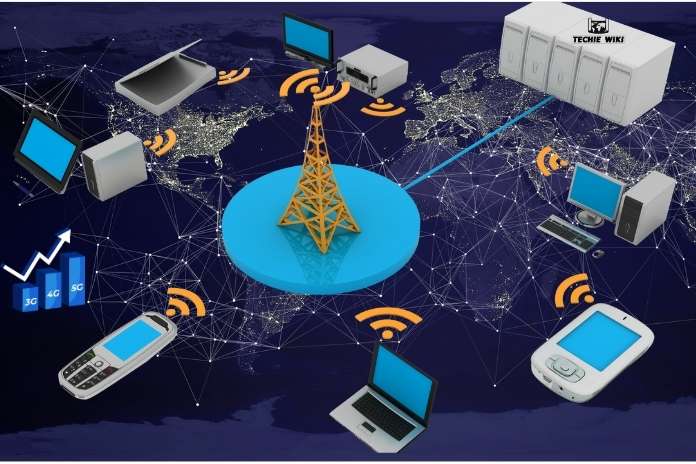
A wireless network connects devices without using physical cables to transmit data. The wireless network uses technologies like microwaves, radio waves, and infrared signals to transmit information between devices. We now see that people more commonly use wireless networks in homes, offices, public places, and mobile communication systems. In this article, we cover the topic of wireless networks, its types, advantages, disadvantages, devices, and common examples.
What Is a Wireless Network?
In computer science and telecommunications, a wireless network is a type of connection between computer systems (i.e., between computers) that is carried out using various waves of the electromagnetic spectrum.
In other words, it’s a node connection that doesn’t require any cabling or wired devices, since information transmission and reception occur through specialized ports. This type of technology differs from traditional wired networking methods.
History Of Wireless Networks
It originated in 1971, when a group of researchers led by American computer engineer Norman Abramson (1932), created at the University of Hawaii ALOHA, the first packet switching system through a radio wave communications network.
ALOHA consisted of seven computers located on different islands in the region, linked to each other by a central server that performed various calculations to supply them. The first problems arose from preventing messages from the different stations from overlapping, which necessitated the creation of the first MAC protocols.
The following year, ALOHA was already connecting to ARPANET, a precursor to the Internet.
Types of Wireless Networks
Wireless networks can be classified based on two different criteria:
Wireless Networks by Coverage Area
According to their coverage area. They are classified similarly to wired networks:
| Type | Full Form | Coverage / typical use |
| WPAN | Wireless Personal Area Network | Short-range connections between nearby personal devices |
| WLAN | Wireless Local Area Network | Local networks such as Wi-Fi in homes, offices, and public places |
| WMAN | Wireless Metropolitan Area Network | Networks covering a larger metropolitan area |
| WWAN | Wireless Wide Area Network | Wide-area connectivity using cellular and other long-distance wireless technologies |
- WPAN is also known as Wireless Personal Area Network. This network has a maximum range of 10 metres, making it suitable for one or two users in close proximity. This type of technology includes Bluetooth, ZigBee, etc.
- WLAN is an acronym for Wireless Local Area Network and is the communications standard on which WiFi technologies are based, capable of reaching a much greater distance using repeaters, interconnecting various types of devices through radio waves.
- WMAN is also known as Wireless Metropolitan Area Network. This network has a much greater range, capable of covering up to 20 kilometres.
- WWAN is also known as Wireless Wide Area Network. This network uses cellular and microwave technologies to transfer data over vast distances. Some of its technology types include GPRS, EDGE, GSM, 3G, 4G, and 5G.
Wireless Networks By Frequency Range
According to their frequency range. Depending on which part of the electromagnetic spectrum they use to transmit, we can distinguish between:
- Terrestrial microwaves: Parabolic antennas about 3 metres in diameter; a microwave signal is emitted that has a range of several kilometres, using frequencies between 1 and 300 GHz.
- Satellite microwaves: This system operates based on a link between two or more base stations, mediated by an orbiting satellite. Each satellite has its own specific frequency bands, but it offers a much greater range and higher speed.
- Infrared: It uses modulators of non-coherent infrared light, which, when aligned directly or reflected off a suitable surface, operate at frequencies between approximately 300 GHz and 384 THz. However, it cannot penetrate walls.
- Radio waves: It uses waves at various frequencies (AM, FM, HF, VHF, UHF, etc.) to transmit and receive information signals, achieving high efficiency over short distances and even through walls, but losing signal as the receiver moves physically away from the transmitter.
Advantages of Wireless Networks
The advantages of wireless networks can be summarised as follows:
- Savings in materials: This is because kilometres of cabling and terrestrial controllers are not required for the exchange of information.
- Faster communication: Wireless networks allow devices to stay connected while in motion or in remote locations.
- Multiple connections: Since more than one device can connect to the same wireless signal simultaneously.
Disadvantages of Wireless Networks
On the other hand, wireless networks have the following limitations:
- They require greater security, since wireless signals can be intercepted by unauthorized devices.
- They are susceptible to interference. This can come from other signals on the same transmission channel or from continuous low-frequency noise, antennas, microwave equipment, or even certain types of metals.
- Transmission is more complex. It requires additional mechanisms and devices to direct the transmission and receiving devices, providing them with sufficient power to achieve a stable and continuous signal.
Devices Used in a Wireless Network
Wireless networks can include the following elements:
- Wireless-enabled devices: To connect to a wireless network, you will need a computer, phone, tablet, or other device equipped with an antenna capable of detecting and transmitting electromagnetic waves—that is, capable of receiving and transmitting radio frequency signals. For this purpose, they must have a working wireless network card.
- Base stations: These are devices that convert a wired or traditional signal into a wireless signal transmitted by radio waves.
- Repeaters: Devices designed to capture and retransmit a specific electromagnetic wave signal to boost it and allow it to reach further or to places otherwise inaccessible.
- Routers and access points: Routers are devices that “translate” the internet signal and direct it to access points so that it can then be distributed by these points to various users on a network. Routers can assign or help manage IP addresses and direct data packets between networks.
Examples of Wireless Networks
Some everyday examples of wireless networks include mobile phone networks, WiFi networks in our homes, in squares or in airports, or satellite microwave transmission.
Another good example is the Bluetooth system with which we connect our wireless headphones to the music player or to the cell phone.
FAQs – Frequently Asked Questions
1. How Does a Wireless Network Work?
A wireless network typically works by using radio waves or other wireless signals to send and receive data between connected devices.
2. What Are The Types Of Wireless Networks?
The main types of wireless networks include WPAN, WLAN, WMAN, and WWAN. These networks are different mainly in their coverage areas.
3. What Devices Are Used In A Wireless Network?
The most common devices that are used in a wireless network include wireless-enabled devices, base stations, repeaters, routers, and access points.
4. What Is The Difference Between Wi-Fi And A Wireless Network?
The difference between Wi-Fi and wireless networks is quite simple, as the Wi-Fi technology is used to connect devices without using physical cables. It is connected within a local network. Whereas the wireless network is a broader concept that includes different types of wireless connections like WPAN, WLAN, WMAN, and WWAN.
Also Read: What Is An Interface In Computing
